The Long Game Pays Off
On June 30, 2023, the Supreme Court delivered its final blow to federal regulatory power in Loper Bright Enterprises v. Raimondo, overturning the Chevron doctrine that had allowed agencies to interpret ambiguous statutes for 40 years. The 6-3 decision, split along ideological lines, represented the culmination of a decades-long project to reshape American law in favor of corporate power. But this wasn't the work of individual justices following their constitutional conscience—it was the predictable outcome of the most successful institutional capture campaign in modern American history.
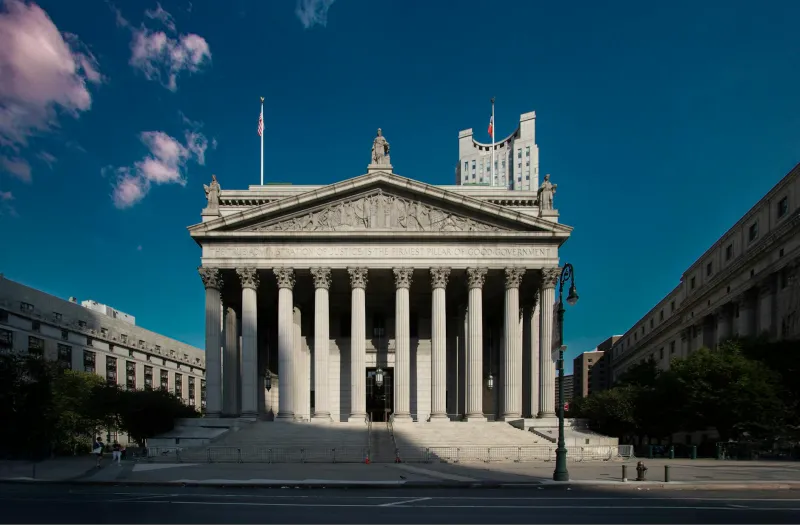
 Photo: Supreme Court, via d.newsweek.com
The Federalist Society, founded in 1982 by a group of conservative law students, has spent four decades building a pipeline from law school to the federal bench. Today, six of the nine Supreme Court justices are current or former Federalist Society members. This isn't coincidence—it's the result of a $250 million investment in reshaping American jurisprudence from the ground up.
 Photo: The Federalist Society, via www.law.uga.edu
The Money Behind the Robes
Between 2014 and 2020 alone, the Federalist Society received over $85 million from anonymous donors, much of it funneled through dark money groups like the Judicial Crisis Network and the 85 Fund. These organizations, funded by billionaires like Leonard Leo and the Koch network, didn't just support conservative judicial nominees—they manufactured them.
The pipeline is remarkably efficient: promising conservative law students receive Federalist Society scholarships, prestigious clerkships with conservative judges, and positions at conservative legal organizations. They attend Society conferences where they network with sitting judges and future Republican administration officials. When judicial vacancies arise, the Society provides pre-vetted candidates to Republican presidents, complete with detailed vetting reports.
This isn't how judicial selection is supposed to work in a democracy. Federal judges receive lifetime tenure precisely to insulate them from political pressure and special interests. The Founders never envisioned a system where a single ideological organization could effectively control judicial appointments for an entire political party.
The Corporate Agenda in Black Robes
The results speak for themselves. Since gaining its current supermajority, the Court has systematically dismantled regulatory authority across multiple domains. In West Virginia v. EPA (2022), they invented the "major questions doctrine" to prevent agencies from addressing climate change without explicit congressional authorization. In Students for Fair Admissions v. Harvard (2023), they struck down affirmative action programs that had helped level educational playing fields for decades.
But the pattern extends far beyond headline-grabbing decisions. A 2023 analysis by the Constitutional Accountability Center found that the current Court rules in favor of corporate interests in 76% of cases involving business regulation—the highest rate since the Lochner era of the early 20th century, when the Court routinely struck down worker protection laws as violations of "economic liberty."
The Court's recent decisions on union organizing, environmental protection, and financial regulation consistently favor the same corporate donors who funded the Federalist Society's rise to power. This isn't judicial philosophy—it's legalized corruption.
Democracy Cannot Function When the Referee Has Been Bought
Conservatives argue that Federalist Society judges simply interpret the Constitution as written, without imposing their policy preferences. But this "originalist" framework conveniently produces outcomes that benefit the wealthy and powerful while constraining democratic governance. When the Constitution's text is ambiguous—which it often is—these judges consistently choose interpretations that limit government's ability to regulate corporate behavior or protect vulnerable populations.
Moreover, the Society's influence extends far beyond the Supreme Court. Over 40% of Trump's federal judicial appointments were Federalist Society members, creating a generation of lower court judges committed to the same pro-corporate ideology. These judges will serve for decades, shaping American law long after current political battles have been resolved.
The human cost is already visible. The Court's gutting of the Voting Rights Act has enabled a wave of voter suppression targeting communities of color. Their abortion decisions have created healthcare deserts across the South and Midwest. Their regulatory rollbacks have weakened worker safety protections and environmental standards that save lives.
The Path Forward
Some Democratic politicians have proposed court expansion or term limits as solutions to judicial capture. But these reforms, however necessary, address symptoms rather than causes. The real problem is that we've allowed a single ideological organization to capture an entire branch of government with minimal public scrutiny.
Transparency requirements would be a start—judicial nominees should be required to disclose their Federalist Society ties and any funding they've received from conservative legal organizations. Ethics reforms should prevent judges from attending Society events or receiving Society-funded trips and speaking fees. And dark money groups that fund judicial confirmation campaigns should face the same disclosure requirements as other political organizations.
But ultimately, the Federalist Society's success reflects a broader failure of Democratic Party strategy. While conservatives spent decades building legal infrastructure, Democrats focused on winning individual elections. The result is a judiciary that will constrain progressive governance for a generation, regardless of electoral outcomes.
The Referee Has Been Bought
The Federalist Society's capture of the federal judiciary represents the most successful long-term political investment in modern American history—and democracy cannot survive when the constitutional referee works for one team.