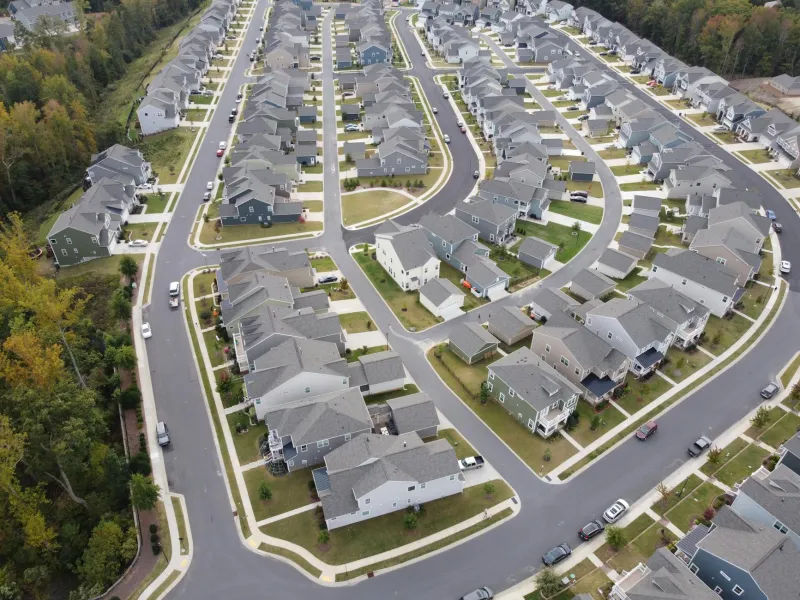
In cities across America, a quiet conspiracy has been unfolding for decades in municipal planning offices and city council chambers. It's not the stuff of shadowy backroom deals or briefcases full of cash — it's far more insidious. Through a web of seemingly innocuous zoning regulations, local governments have systematically engineered housing scarcity, racial segregation, and economic apartheid, all while maintaining the veneer of democratic governance and community input.
The Architecture of Exclusion
The tools of this exclusion are deceptively mundane: minimum lot sizes that require half-acre plots for single homes, parking requirements that mandate two spaces per unit regardless of transit access, height restrictions that cap buildings at two stories in areas crying out for density, and single-family zoning that prohibits apartments, duplexes, or any housing type that working families might actually afford.
These aren't accidents of bureaucratic inertia. They're the deliberate product of what housing economists call "exclusionary zoning" — a system designed to preserve neighborhood "character," which has become a euphemism for keeping out anyone who can't afford a $800,000 starter home.
Consider the numbers: According to the National Association of Home Builders, zoning and regulatory costs now account for nearly 25% of the final price of a new home, adding an average of $93,870 to construction costs. In high-cost markets like California, that figure can exceed $200,000 per unit. These aren't unavoidable infrastructure costs — they're artificial barriers erected by local governments at the behest of existing homeowners who view housing scarcity as a feature, not a bug.
The Homeowner Protection Racket
The political coalition behind exclusionary zoning reads like a who's who of American privilege: affluent homeowner associations that treat property values like a religion, local politicians who depend on their votes, real estate interests that profit from artificial scarcity, and planning consultants who make their living designing ever more creative barriers to development.
Homeowner associations, in particular, have become the shock troops of housing exclusion. Armed with legal standing to challenge any development that might increase density, these groups have weaponized environmental review processes, historic preservation laws, and "community input" sessions to block affordable housing projects. In California alone, homeowner groups filed over 300 CEQA lawsuits against housing developments in 2022, using environmental law as a cudgel against working families seeking homes.
The playbook is predictable: First, invoke "neighborhood character" and "local control." Then, raise concerns about traffic, parking, and school overcrowding. Finally, if all else fails, discover sudden environmental concerns or historic significance in whatever plot of land developers want to build on. The result is a system where existing homeowners hold veto power over housing for everyone else.
The Racial Wealth Gap by Design
The exclusionary effects aren't colorblind accidents. They're the direct descendants of redlining and racial covenants, updated for the post-civil rights era. When explicit racial exclusion became illegal, local governments simply shifted to economic exclusion that achieved the same segregated outcomes.
The data is stark: According to the Brookings Institution, the median white family has eight times the wealth of the median Black family and five times that of the median Latino family. Much of this gap stems from differential homeownership rates and property values — gaps that exclusionary zoning actively perpetuates by concentrating affordable housing in already disadvantaged communities while protecting wealthy enclaves from any meaningful integration.
In practice, this means a teacher or firefighter in San Francisco — public servants we claim to value — can't afford to live in the communities they serve. It means families spend three hours daily commuting from distant suburbs because zoning laws have banned apartments near job centers. It means entire generations are locked out of wealth-building through homeownership because local governments have made housing a luxury good.
 Photo: San Francisco, via 2.bp.blogspot.com
State Pushback and Federal Potential
A growing number of states are finally pushing back against municipal housing apartheid. California's SB 9 and SB 10 allow property owners to split single-family lots and build duplexes, while SB 423 streamlines approval for affordable housing projects. Montana passed legislation preventing local governments from banning certain housing types, and New York is considering similar reforms.
The backlash has been swift and predictable. Local officials cry about "state overreach" and the loss of "local control" — the same arguments used to defend segregated schools and discriminatory lending. Real estate lobbying groups have poured millions into campaigns against zoning reform, often hiding behind astroturf neighborhood groups with names like "Preserve Our Communities."
But the momentum is building. Oregon eliminated single-family zoning statewide in 2019. Minneapolis followed suit in 2021. These aren't radical experiments — they're returns to the mixed-use, diverse neighborhoods that characterized American cities before zoning laws carved them into economic segregation zones.
The Federal Housing Emergency
The Biden administration has recognized that local zoning is a national crisis requiring federal intervention. The White House's housing plan includes incentives for communities that reform exclusionary zoning and penalties for those that don't. But given the scale of the crisis — America needs 3.8 million additional housing units just to meet current demand — federal action must be far more aggressive.
Congress should condition federal transportation and infrastructure funding on zoning reform, just as it once used highway funding to enforce the national drinking age. The Department of Housing and Urban Development should investigate exclusionary zoning as a violation of fair housing law. And the Federal Housing Administration should refuse to insure mortgages in communities that actively restrict housing supply.
Beyond the Zoning Cartel
The housing crisis isn't a natural disaster or market failure — it's the predictable result of policy choices made by local governments that prioritize the wealth of existing homeowners over the basic human need for shelter. Every minimum lot size requirement, every parking mandate, every height restriction is a choice to value property values over people.
Breaking up the zoning cartel won't solve America's housing crisis overnight, but it's a necessary first step toward a more just and affordable future. The question isn't whether we can afford to reform exclusionary zoning — it's whether we can afford not to.
In a nation that claims to believe in equality of opportunity, using municipal law to hoard housing for the wealthy isn't just bad policy — it's a betrayal of our democratic values that demands immediate and decisive action.