When the Insurer Leaves Town: How the Climate-Driven Insurance Collapse Is Setting Up America's Next Great Wealth Catastrophe

Photo of Gavin Newsom, via Wikimedia Commons
The Letter No Homeowner Wants to Find
In the summer of 2024, Patricia Moreau received a non-renewal notice from her homeowner's insurance carrier. She had lived in her St. Bernard Parish, Louisiana home for 22 years, had never missed a payment, had filed only one claim — after Hurricane Ida — and had made every repair the insurer required. None of it mattered. The carrier was exiting Louisiana's coastal market entirely. The letter was polite, bureaucratically precise, and financially devastating.
Moreau's story is being replicated tens of thousands of times across the country's climate-exposed geography. In California, seven of the twelve largest homeowner's insurers — including State Farm and Allstate — have paused or restricted new policy issuance, with State Farm announcing in 2023 that it would not renew approximately 72,000 existing policies. In Florida, at least 11 insurance companies have become insolvent or withdrawn from the market since 2020, according to the Florida Office of Insurance Regulation. In Louisiana, the state's insurer of last resort — Louisiana Citizens Property Insurance — has seen its policy count surge past 130,000 as private carriers retreat, with premiums that have doubled or tripled for policyholders who have no other option.
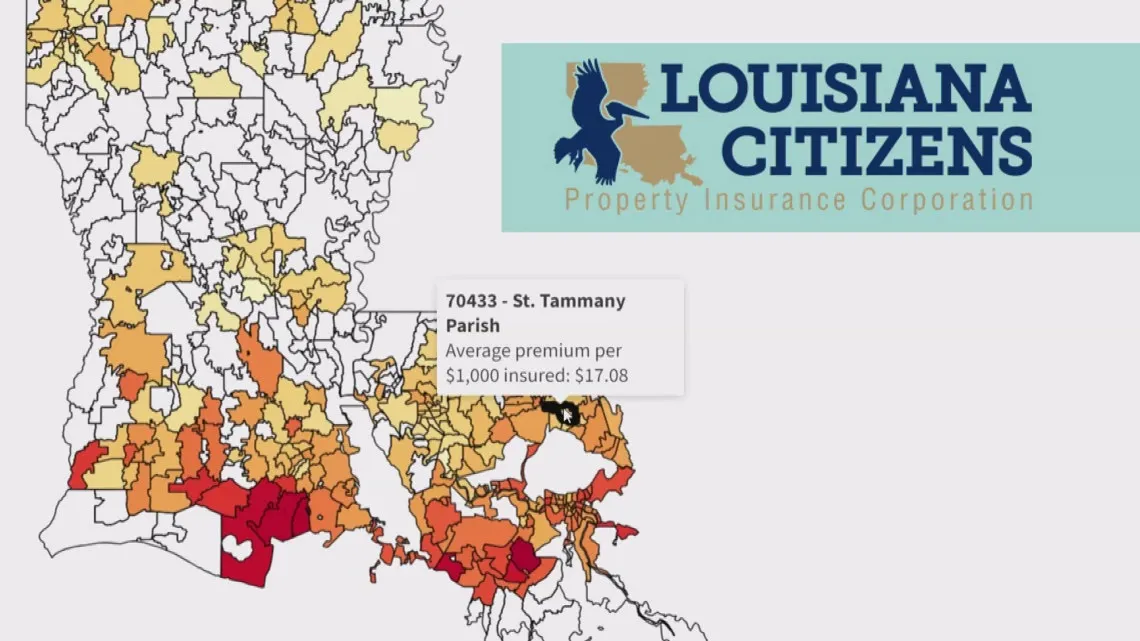 Photo: Louisiana Citizens Property Insurance, via media.wwltv.com
This is not a market correction. It is a market abandonment — and the people left behind are not the ones who can afford to absorb the blow.
Insurance Is Not an Amenity. It Is Infrastructure.
The framing of the insurance crisis as a private market problem — carriers responding rationally to escalating risk, premiums reflecting actuarial reality, homeowners who chose to live in risky places bearing the consequences of that choice — is seductive in its simplicity and disastrous in its implications.
Insurance is not a luxury product. It is the foundational financial infrastructure upon which American homeownership, and by extension American middle-class wealth accumulation, is built. Federal mortgage lenders require it. Home equity lines of credit require it. The entire system of using a home as a store of wealth — the primary savings vehicle for the majority of American families — depends on the assumption that a disaster will not permanently zero out that asset.
When insurance disappears, the cascade is swift and brutal. Property values in uninsurable areas decline as the pool of potential buyers shrinks to cash purchasers only — a category that skews heavily toward institutional investors and private equity firms. Existing homeowners cannot refinance or access home equity loans on uninsured properties. They cannot sell at anything approaching pre-crisis valuations. And when the disaster comes — as it will, with increasing frequency and severity — they cannot rebuild.
A 2023 analysis by the First Street Foundation estimated that climate-related insurance risk could reduce property values in the most exposed U.S. markets by as much as $1.2 trillion over the next decade. That wealth destruction will not be distributed evenly. It will fall hardest on communities that built their economic stability through homeownership precisely because other wealth-building pathways — stock market participation, business ownership, inherited capital — were historically closed to them.
Who Gets Abandoned First
The geography of insurance retreat maps almost precisely onto the geography of racial and economic vulnerability in America. Coastal Louisiana — where Black homeownership rates are high and generational wealth is deeply tied to land — is among the most acutely affected regions in the country. The Florida counties losing private coverage at the fastest rates include communities with significant Latino and Black populations in the Miami-Dade, Broward, and Palm Beach corridors. In California, the communities most affected by insurer withdrawals include majority-Latino agricultural towns in the Central Valley and lower-income coastal and foothill communities that lack the political capital of wealthier enclaves.
This is not coincidence. It is the spatial logic of a system in which decades of discriminatory lending, redlining, and exclusion from suburban development pushed communities of color into the most environmentally exposed geography — floodplains, fire corridors, coastal lowlands — and now those same communities are being told by the market that the risk it helped create is theirs alone to bear.
The numbers are stark. According to the NAACP and the National Fair Housing Alliance, Black homeowners in climate-exposed areas already pay disproportionately higher insurance premiums relative to property value than white homeowners in comparable risk categories. As carriers exit and state plans of last resort take over, those disparities widen further, consuming an ever-larger share of household income from families who were already operating with less margin.
The Market-Fundamentalist Counter-Argument
The insurance industry and its defenders offer a coherent response: carriers are not charities. They cannot remain solvent by underwriting risks that exceed the premiums the market will bear, particularly in states where regulators have historically suppressed rate increases below actuarially justified levels. California's Department of Insurance, under pressure from consumer advocates, held homeowner's insurance rates artificially low for years under Proposition 103's approval requirements — and the predictable result was that insurers found the market unsustainable and left.
This argument has real merit as a diagnosis. Where it fails is as a prescription. Acknowledging that private insurers cannot profitably cover catastrophic climate risk at affordable premiums does not lead logically to the conclusion that the market should simply be allowed to fail and homeowners left to absorb the consequences. It leads to the conclusion that catastrophic climate risk has become a public problem requiring a public solution — just as flood risk along major rivers was addressed through the National Flood Insurance Program in 1968, just as deposit insurance addressed the systemic risk of bank runs, just as Medicare addressed the market's rational refusal to insure elderly people at affordable premiums.
The question is not whether the market can handle this. It clearly cannot. The question is whether government will act before the collapse is complete.
The Policy Toolkit That Exists — and the Will That Doesn't
The architecture for federal intervention already exists in embryonic form. The National Flood Insurance Program, despite its own fiscal dysfunction, demonstrates that federal backstop mechanisms for catastrophic climate risk are legally and administratively feasible. The Treasury Department's Federal Insurance Office has the statutory authority to monitor systemic insurance market failures and recommend legislative responses. The Community Development Financial Institutions Fund could be expanded to provide bridge financing for uninsured homeowners facing rebuilding costs.
What is missing is not the policy toolkit. It is the political will to use it — and the ideological willingness to name what is happening for what it is: a market failure of systemic, society-wide proportions that requires collective response.
Several proposals have been floated in Congress, including a federal reinsurance backstop for catastrophic climate events and reforms to the National Flood Insurance Program that would extend coverage to wildfire and wind damage. None has advanced past committee hearings. The insurance lobby, meanwhile, spent over $160 million on federal lobbying between 2020 and 2024, according to OpenSecrets data, with significant contributions to the members of the House Financial Services and Senate Banking committees with jurisdiction over insurance regulation.
A Wealth Stripping Event in Slow Motion
The 2008 financial crisis erased approximately $13 trillion in household wealth, according to Federal Reserve data, with the damage concentrated among Black and Latino homeowners who had been steered into subprime mortgages. The recovery of that wealth took the better part of a decade, and for many communities of color, it never fully arrived.
The climate insurance collapse is a different mechanism but the same directional logic: a systemic shock, structured by decades of policy choices, absorbing wealth from the most vulnerable and transferring it — through distressed property sales, institutional buyouts, and underinsured disaster losses — to those with the capital to wait it out.
The difference is that this time, the shock is visible in advance. The insurers are not hiding what they are doing. The rate filings are public. The non-renewal notices are in the mail. The question is whether America will treat this as the infrastructure emergency it is — or whether it will wait until the collapse is complete and then ask how no one saw it coming.
The insurance industry's retreat from climate risk is not a market signal to be respected — it is a five-alarm warning that only federal action, not further market deference, can answer.