Seized in the Public Interest: How Corporate America Hijacked Eminent Domain to Take Your Land for Private Gain

A Founding Power, Fundamentally Betrayed
The Fifth Amendment to the United States Constitution grants government the power to take private property for public use — but only with just compensation and, crucially, only for the public's benefit. It is a power the framers understood to be extraordinary, a last resort reserved for genuine collective necessity: a courthouse, a road, a levee. What the framers did not envision, and what a succession of state legislatures and deferential courts have permitted, is that this sovereign authority would be delegated wholesale to private corporations — pipeline operators, data center developers, transmission line builders — who use it to seize American homeowners' land not for the public good, but for private profit.
Across the country, from the cornfields of Iowa to the red clay of Georgia, from rural Appalachian hollows to Indigenous-held lands in the Dakotas, families are receiving condemnation notices from corporations they have never dealt with, offering below-market compensation for land their families have held for generations. When they refuse, lawyers appear. When lawyers fail, bulldozers follow. And the legal architecture enabling this has been constructed, piece by piece, by state legislatures that have quietly expanded the definition of "public use" until it encompasses nearly any infrastructure project a well-capitalized corporation chooses to build.
The Legal Unraveling Began in 2005
The Supreme Court's 2005 decision in Kelo v. City of New London remains the most controversial eminent domain ruling in modern American legal history. In a 5-4 decision, the Court held that the transfer of property from one private owner to another private developer could constitute a "public use" if it was part of a broader economic development plan that would generate public benefits — jobs, tax revenue, urban revitalization. Justice John Paul Stevens, writing for the majority, acknowledged the difficulty of the decision; Justice Sandra Day O'Connor, in dissent, warned that the ruling would allow "the specter of condemnation" to hang over every home and small business.
O'Connor was right. While Kelo technically involved a municipality, not a private corporation, its logic — that diffuse public benefits can justify private takings — has been extended and exploited by industry. More than 40 states passed post-Kelo reform legislation, but many of those reforms were narrow, riddled with carve-outs for specific industries, and have been further eroded by subsequent court decisions. The practical result is that pipeline companies, in particular, have secured the right to condemn private land in most states where they operate, on the theory that natural gas or oil pipelines serve a public interest in energy supply — even when the pipeline's primary function is to transport privately owned fuel to export terminals for sale on global commodity markets.
The Pipeline Corridor as a Corporate Right-of-Way
Consider the Mountain Valley Pipeline in West Virginia and Virginia, or the Dakota Access Pipeline in the upper Midwest. Both projects triggered fierce resistance from landowners and tribal nations, and both ultimately proceeded over that resistance, in significant part through the use or threat of eminent domain. The Dakota Access Pipeline, routed through lands with profound cultural and spiritual significance to the Standing Rock Sioux Tribe, became a flashpoint for the broader conflict between Indigenous sovereignty and corporate infrastructure rights. Despite the tribe's documented treaty claims and the Army Corps of Engineers' own environmental review concerns, the pipeline was ultimately built — and the communities that bore the risk of a spill were not the communities that received the economic benefit.
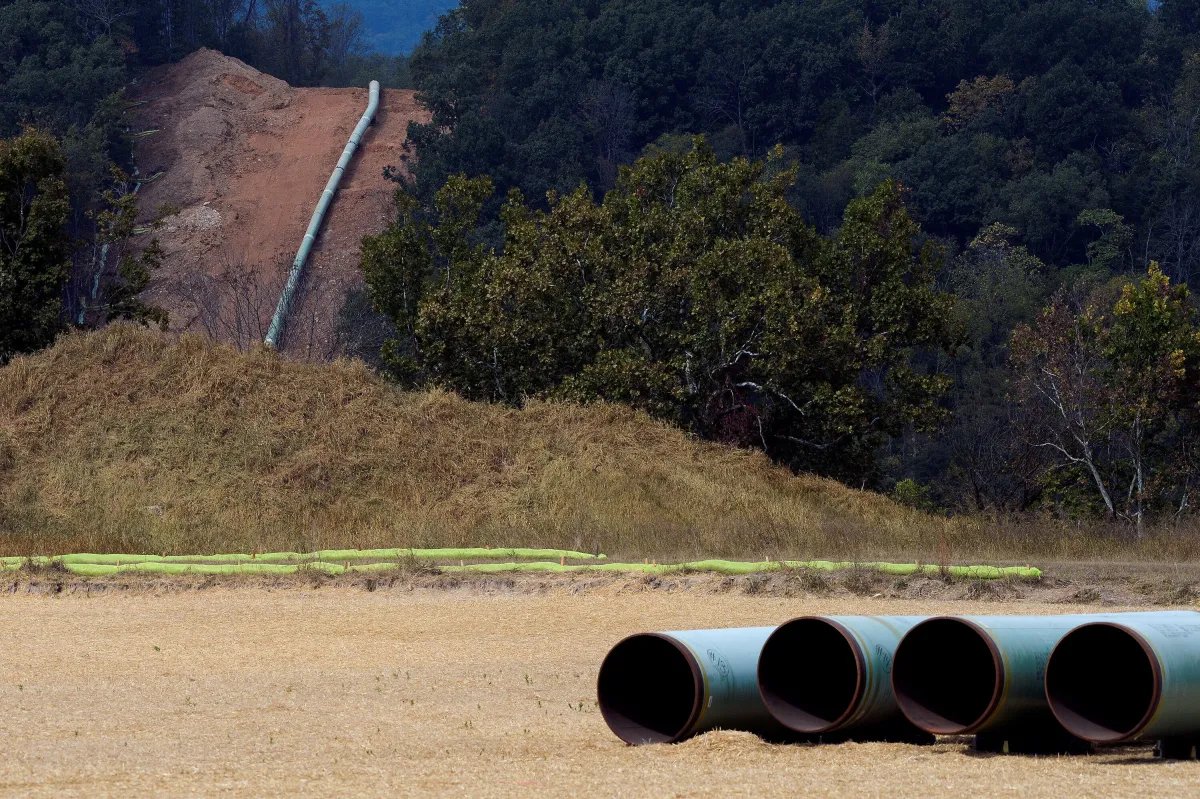 Photo: Mountain Valley Pipeline, via www.reuters.com
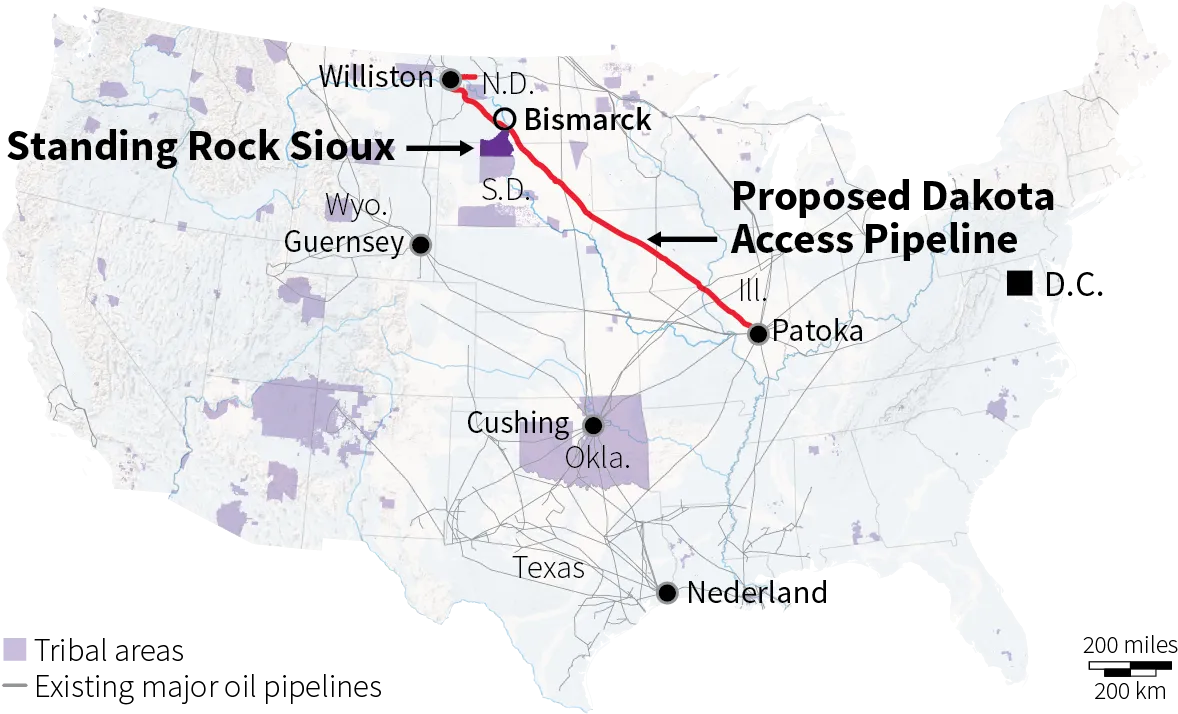 Photo: Dakota Access Pipeline, via www.pngkit.com
 Photo: Standing Rock Sioux Tribe, via media.newyorker.com
This asymmetry is not incidental. It is structural. Pipeline routes are not determined by geographic necessity alone; they are determined by the path of least legal and political resistance, which in practice means routing through rural, low-income, and minority communities whose political power to resist is limited. A 2021 study by the Union of Concerned Scientists found that communities of color and low-income communities are disproportionately burdened by fossil fuel infrastructure, including pipelines. The eminent domain mechanism accelerates this pattern by removing one of the few tools — the ability to simply refuse — that property owners in these communities possess.
The Data Center Land Grab
The pipeline industry's abuse of eminent domain is well-documented, but a newer and less-scrutinized frontier is emerging: the use of condemnation authority to assemble land for data centers and private transmission lines. As artificial intelligence and cloud computing drive explosive demand for electricity, technology companies and their utility partners are seeking to build massive new transmission infrastructure. In several states, legislation has been introduced or passed that would extend eminent domain authority to private transmission developers, allowing them to condemn rural land for power lines that will primarily serve the energy needs of corporate data centers — facilities owned by some of the wealthiest companies in human history.
Virginia, which hosts the largest concentration of data centers in the world, has been a testing ground for these dynamics. Landowners in rural counties have found themselves facing condemnation proceedings initiated not by the state government but by private utility affiliates acting on behalf of corporate clients. The "public use" justification offered is that electricity transmission serves a general public interest — a legal argument that courts have largely accepted, even when the primary beneficiary is a private corporation's server farm.
The Strongest Counterargument, and Its Limits
The most serious case for broad eminent domain authority rests on a genuine policy problem: infrastructure is genuinely hard to build when any single landowner can hold an entire project hostage. A transmission line that must cross a thousand parcels of land is functionally impossible to construct through voluntary negotiation alone, and the public interest in a functioning electrical grid, or a connected transportation network, is real. The "holdout problem" is not a fiction invented by industry lobbyists.
But acknowledging this problem does not require accepting the current system. The question is not whether eminent domain should exist — it should — but who should wield it, for whose benefit, and with what procedural protections for those displaced. A power reserved by the Constitution for public use should not be delegated to private corporations whose shareholders bear no democratic accountability. Compensation standards should reflect genuine market value, including the intangible but real value of generational land ties — something current "just compensation" formulas systematically undervalue. And routing decisions for major infrastructure should be subject to environmental justice review that considers who bears the burden and who receives the benefit.
The Broader Democratic Stakes
Eminent domain abuse is not merely a property rights issue — it is a democracy issue. When corporations can deploy state power to override the decisions of individual citizens and communities, the line between public authority and private interest dissolves in ways that should trouble anyone committed to democratic self-governance, regardless of where they sit on the ideological spectrum. That is why resistance to pipeline condemnation has produced unusual coalitions: progressive environmental groups and libertarian property rights advocates, Indigenous sovereignty movements and rural conservative farming communities, finding common cause against a system that serves neither.
The political moment for reform is real. Several states are reconsidering the scope of their condemnation statutes, and federal legislation to establish minimum procedural standards for private eminent domain has been proposed, if not yet passed. The 2026 election cycle will feature contested Senate races in states — Iowa, Montana, North Carolina — where agricultural landowners have direct experience with corporate condemnation. That is a constituency with political weight, if progressives are willing to make the case in language that resonates beyond the coastal cities.
Property seized for private profit is not eminent domain — it is expropriation with legal paperwork, and it is long past time to call it what it is.