Seized for Progress: How Eminent Domain Became a Tool for Displacing Black and Indigenous Communities
When 'Public Use' Becomes Private Profit
The Fifth Amendment to the United States Constitution grants the government the power to seize private property — but only for "public use" and only with "just compensation." These two conditions were designed as guardrails. They have, over the course of American history, been systematically dismantled. What remains is a legal mechanism that, in far too many documented cases, functions as a government-backed subsidy for corporate land acquisition — and the communities most likely to lose their property are Black, Indigenous, and low-income Americans who have the fewest resources to fight back.
The story of eminent domain abuse in the United States is not a series of isolated incidents. It is a pattern — one with deep roots in racial exclusion and a present-day expression in pipeline corridors, stadium footprints, and developer-driven "revitalization" projects that invariably seem to require the removal of people who have lived on a piece of land for generations.
Kelo and the Door It Left Open
No single legal moment accelerated this dynamic more than the Supreme Court's 2005 ruling in Kelo v. City of New London. In a 5-4 decision, the Court held that the government could transfer private property to another private party — in this case, a pharmaceutical company's development project — so long as the broader economic development could be characterized as a public benefit. Justice John Paul Stevens, writing for the majority, concluded that the city's development plan qualified as "public use" under the Fifth Amendment.
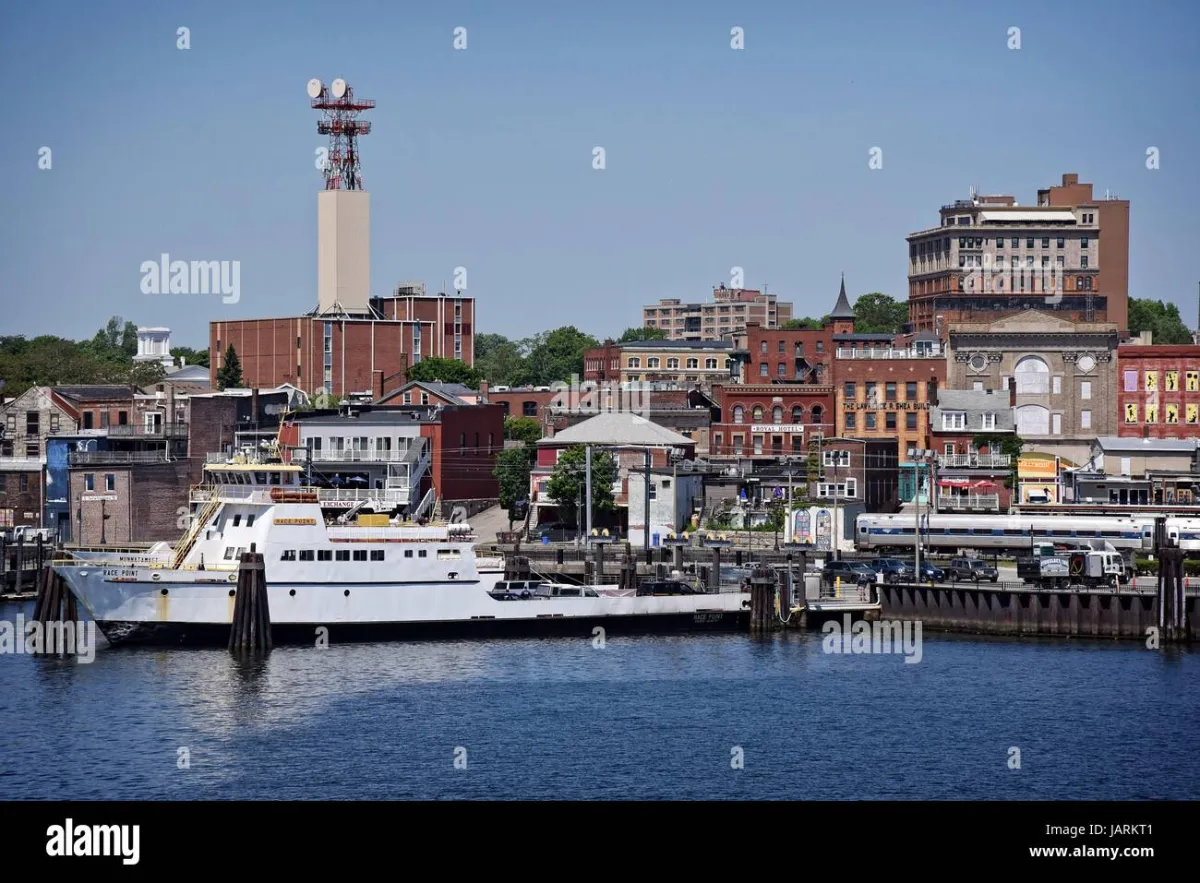 Photo: New London, via c8.alamy.com
The dissents were scalding. Justice Sandra Day O'Connor warned that the ruling effectively eliminated any meaningful distinction between private and public use, writing that "the specter of condemnation hangs over all property." Justice Clarence Thomas went further, noting the historical pattern: "Losses will fall disproportionately on poor communities. Those communities are not only systematically less likely to put their lands to the highest economic value uses, but are also the least politically powerful."
Thomas was right. A study by the Institute for Justice — which litigated Kelo — found that eminent domain actions in the years surrounding the ruling were concentrated in communities with lower incomes, higher proportions of minority residents, and lower property values. The "public use" rationale was functioning, in practice, as a mechanism for economic cleansing.
New London itself became a cautionary tale. The development project for which Susette Kelo and her neighbors lost their homes was never built. The land sat vacant for years. The community was destroyed. The promised economic revival never arrived.
'Blight' as Legal Cover
One of the most frequently used tools in the eminent domain arsenal is the designation of a neighborhood as "blighted." Blight designations unlock a range of government powers, including the ability to condemn properties and transfer them to private developers at below-market rates. In theory, blight law targets genuinely deteriorated structures. In practice, the definition of blight has been stretched so far that it has been applied to functioning homes, thriving small businesses, and intact community institutions.
In Detroit, Pittsburgh, Baltimore, and across the urban South, blight designations in the mid-twentieth century provided legal cover for what urban planners themselves sometimes called "Negro removal" — the systematic demolition of Black neighborhoods to make way for highways, universities, and downtown commercial development. Historian Samuel Zipp and others have documented how urban renewal programs displaced an estimated 300,000 to 500,000 families between 1949 and 1973, with African Americans representing a vastly disproportionate share of those displaced.
That history is not merely historical. The same legal architecture remains available today, and it continues to be deployed. In cities experiencing gentrification pressure — Atlanta, Austin, Nashville, Philadelphia — blight designations have been used in recent years to accelerate the removal of long-standing Black and Latino communities from land that has suddenly become valuable to developers.
Pipeline Companies and Indigenous Land
If urban renewal represented one face of eminent domain abuse, the fossil fuel industry represents another. Pipeline companies across the United States have invoked eminent domain authority — in many states, private pipeline operators hold condemnation power under state law — to force easements across private and tribal land, frequently paying far below fair market value and offering landowners little meaningful legal recourse.
The Dakota Access Pipeline controversy brought this dynamic to national attention, though the legal and political dimensions of that fight extended well beyond standard eminent domain proceedings. What it illustrated, however, was the asymmetry of power between a well-capitalized energy company backed by state authority and Indigenous communities whose treaty rights, cultural claims, and legal standing were treated as obstacles rather than protections.
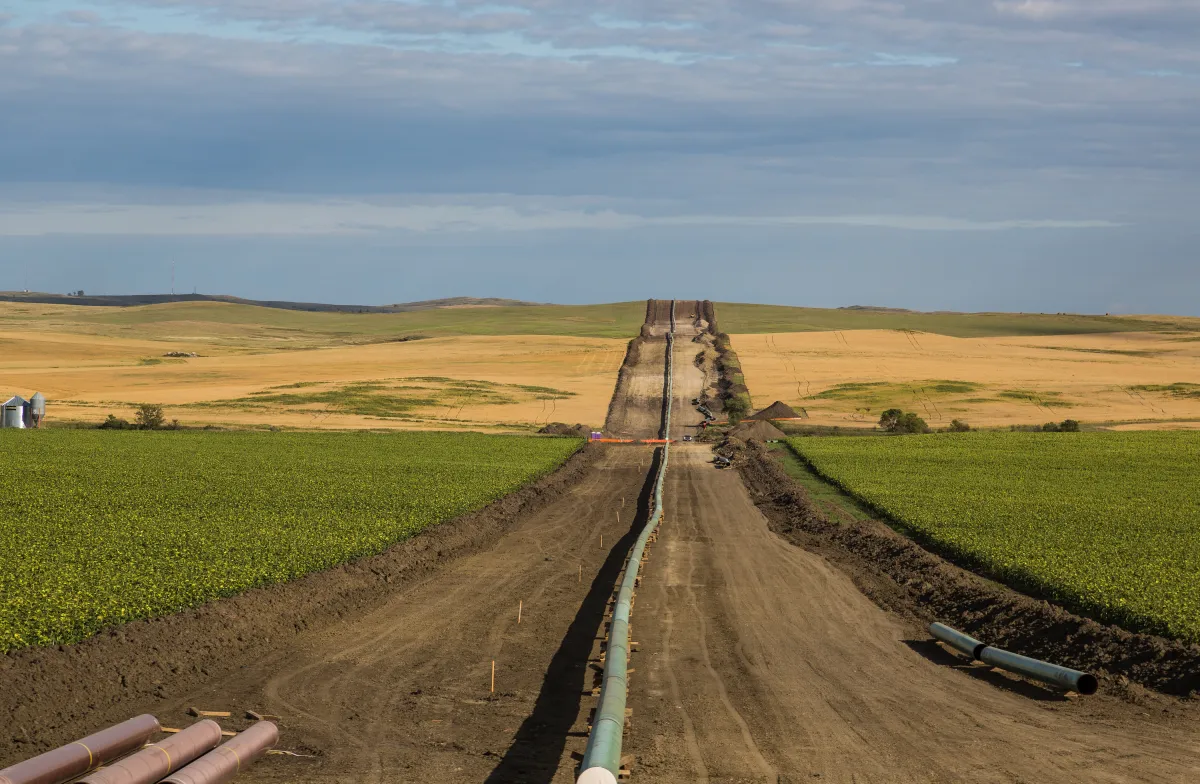 Photo: Dakota Access Pipeline, via www.indianz.com
In Iowa, landowners who refused to grant easements for the Dakota Access Pipeline faced condemnation proceedings initiated by Energy Transfer Partners, a private corporation. In Texas, the Mountain Valley Pipeline and other projects have triggered similar disputes. Landowners — many of them elderly, rural, and without access to specialized legal counsel — routinely accept lowball settlements because the cost and complexity of litigation makes resistance impractical. The power imbalance is structural, and it is intentional.
Just Compensation That Isn't
The constitutional requirement of "just compensation" is typically interpreted to mean fair market value. But fair market value is itself a contested concept, particularly for communities whose property has been historically undervalued due to discriminatory appraisal practices, redlining, and exclusionary zoning. A Black family whose home was appraised at a fraction of its true worth because of decades of discriminatory lending and assessment practices will receive "just compensation" calibrated to that artificially suppressed value — not to what the property would have been worth in an equitable market.
This means that even when the law is technically followed, the outcome can perpetuate the original injustice. The compensation is calculated using a baseline corrupted by racism, and the community loses not only its land but the intangible value of place — the social networks, the institutional memory, the accumulated belonging that cannot be captured in a check.
What Reform Looks Like
Some states responded to Kelo by passing legislation limiting economic development as a basis for condemnation. More than 40 states enacted some form of post-Kelo reform, though the strength of those reforms varies enormously. Several states have strengthened protections for agricultural land and homestead properties. A handful have moved to require independent appraisals and enhanced compensation for displaced residents.
But federal reform has stalled. Advocates including the Institute for Justice and a coalition of civil rights organizations have called for a federal standard that prohibits the transfer of condemned property to private parties for economic development, requires enhanced compensation for low-income and minority landowners, and establishes independent oversight of blight designations. None of these measures have advanced through Congress.
Meanwhile, the communities most affected continue to organize. Indigenous land defenders, Black homeowner associations, and rural landowner coalitions are building legal and political infrastructure to resist seizures — often with limited resources and against well-funded corporate opponents who understand that delay and legal complexity are their most powerful tools.
The Verdict
Eminent domain is a legitimate governmental power when used with genuine restraint for genuine public necessity — but two decades after Kelo ripped away the guardrails, the United States still lacks the federal framework needed to prevent the government's power of seizure from functioning as a subsidy for displacement, and the communities paying that price have waited long enough for the law to catch up with justice.